.svg)


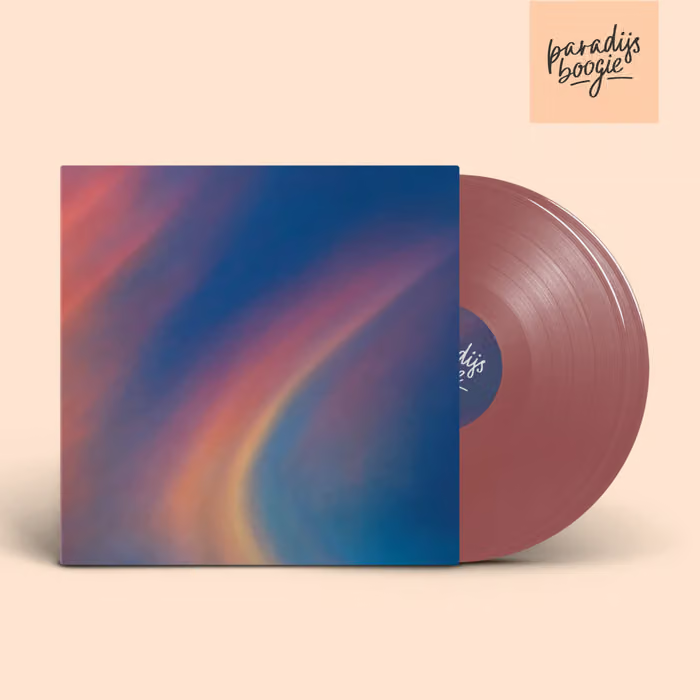
Jakob Mader discusses new album 'A Matter Of Time' for Freund der Familie's Paradijs Boogie sub-label...

With a keen sense for intricate arrangements and hypnotic grooves, Jakob’s debut on Paradijs Boogie crafts a sonic universe that invites both dreaming and dancing. His productions strike a delicate balance between organic elements and contemporary club aesthetics, always driven by a deep passion for musical innovation.
When you began shaping A Matter Of Time, were you working from a defined conceptual framework, or did the meaning emerge retrospectively through the act of making?
A bit of both. I was unsure, if I was able to produce a concept album, but had the dream about that for a long time. So I just started making music with the focus on nostalgia and the music I had in mind when thinking about the first electronic records which influenced me. Trying to reconstruct the feeling that this kind of deep house gives me, though with my own interpretation of it became my goal. And after a lot of studio sessions I realized the concept was about time, reminiscence and the feel of music. And suddenly my album was there and everything made sense to me.
The record feels attentive to duration and restraint, almost as if each element is given permission to exist fully. How do you negotiate that balance between presence and excess when arranging?
Happy to hear that. I developed a music taste that is more about reduction than too much elements, melodies, etc. A lot of music today is full of effects and just too much of everything for my personal taste. So I try to let the elements breathe, sometimes it’s also a little challenge for the listener to take a step back and enjoy every sound without waiting for the next big drop or effect to happen.
There’s a subtle tension between the organic and the synthetic throughout the album. Do you see these as opposing forces to reconcile, or as part of the same continuum within your sound?
I try to connect the dots. There are some recordings of nature, very subtle but still noticaeble or a bit of noise, distortion and dirt every now and then. These elements are important for me because of the oldschool feel. But also as an attempt to get into a deeper connection with sounds, for example from a synthesizer or a sample. I’m trying to manipulate the sound and bring my artistic ideas into it without getting lost in sound design to build personal connection with the elements.
Your use of space feels deliberate, not just as absence, but as a compositional tool. How do you think about negative space in relation to groove and emotional weight?
I think music sometimes needs breaks, a bit of silence and that is also wholesome to the dynamics of a track. It’s about tension and release. To be honest, I was surprised to see people dancing to the deeper and more emotional tracks like „Infinity Groove“ or „Together Alone“ when I played them, because they both have long and filtered breaks before they drop. It seems that bringing elements back after a moment of silence or space is all you need to touch people. Maybe I also have to work on my self confidence as a producer.
The harmonic language often leans into ambiguity rather than resolution. Are you consciously avoiding closure in your chord work, or does that emerge intuitively through repetition and listening?
It’s all about repetition and working with reduced elements, though I’m not really into producing the even more minimalistic genres. Dancing to spheric and dreamy elements can lead to a very own experience if you listen to that kind of deep house for a whole evening and that is just a beautiful thing. Everyone can have an own interpretation of the feelings inside the music.
In terms of process, how much of the album is the result of iterative refinement versus committing to early decisions? Do you tend to preserve initial gestures, or dismantle them over time?
Each session is different, maybe I start with a feeling, sometimes with an inspiration out of nature, a moment in the everyday life or a specific genre, song or artist I had in mind - of course without the aim to copy something, more to interpret something and to build a subtle reference. A lot of times I just record a bunch of ideas, and most of the time way too many of them. In the following weeks I come back to the project every now and then, reduce elements, delete them and emphasize the important ones. That process is always the same, reducing, focussing and finding a balance between reduction and boredom.
There’s an undercurrent of memory and nostalgia running through the record, but it never feels referential in an obvious way. How do you approach influence without slipping into pastiche?
It’s the soundtrack of specific moments, chapters in life, for example the years of learning to DJ with friends while I was studying and sometimes just a track I would like to play in my DJ sets, that feels timeless and bittersweet. The kind of stuff you want to hear when the sun comes out after a long night in a club. That vague feelings and moments I put into the tracks, that makes people feel nostalgic but unspecific and open for own interpretations. 8. If time is both the subject and the structure of the album, how do you feel that translates into the listener’s experience, are you guiding their perception, or allowing it to unfold independently of your intent? Everyone can have an own listening experience and version of this album, I don’t aim for a certain statement, conclusion or message. Some of my friends had the same moments like me in mind while listening, that made me very happy. It’s my musical world, a reflection of musical background, but every listener shall have a personal experience with the music. In that angle of view it’s not my, it’s our music. And that’s what it’s all about, right?
BUY: https://freundderfamilie.bandcamp.com/album/a-matter-of-time