.svg)



Placidum boss Shcaa discusses his new 'Latitudes' LP under his Ain° guise
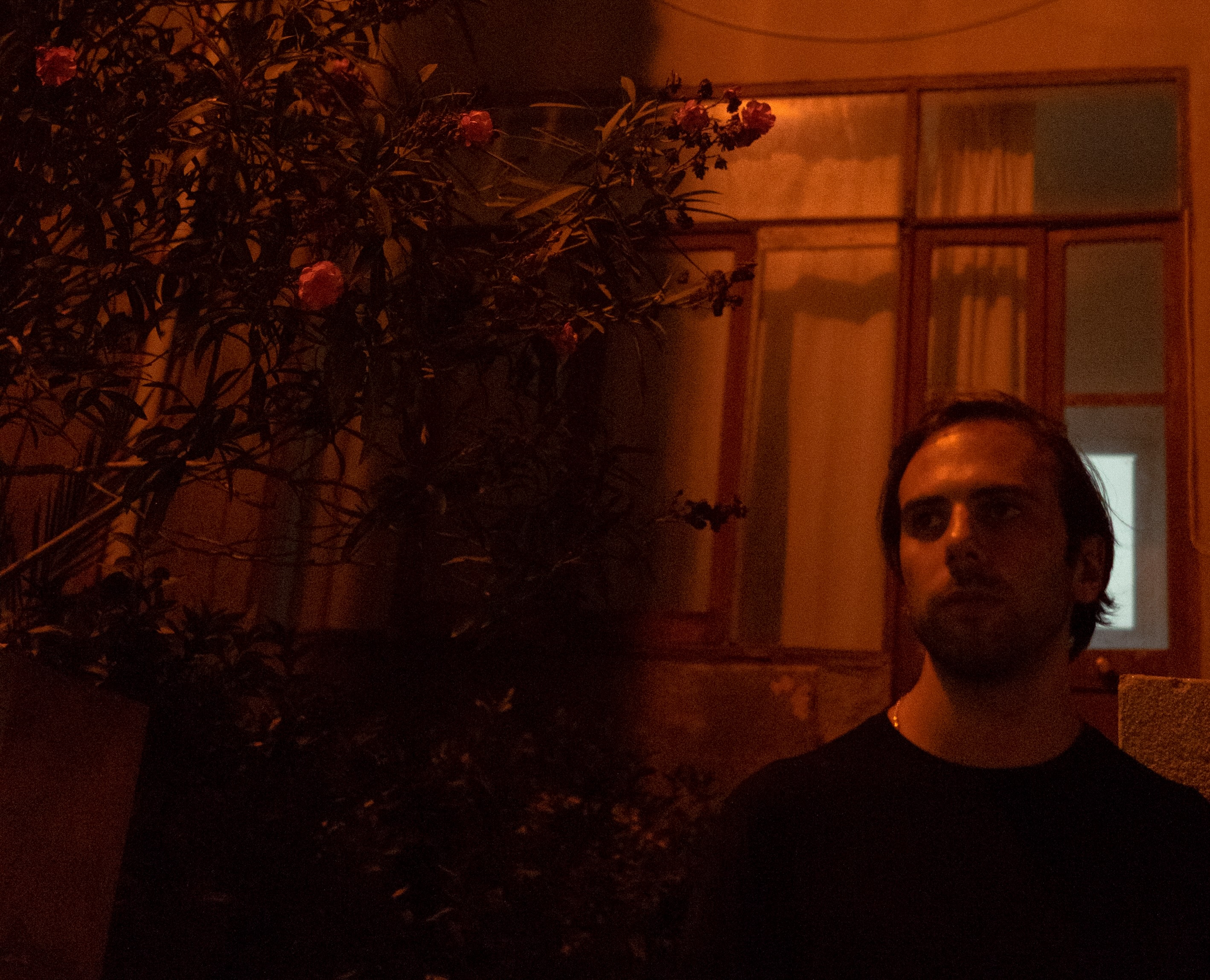
Latitudes is framed as a “slow dispersal” rather than a definitive ending — how did you approach closing this trilogy in a way that resists resolution, and what did that sense of outward drift allow you to express that the previous records didn’t?
I waited, I let it come to me. I’ve been holding on to this album title for probably eight or nine years, same for the photograph. I had an intuition that I needed to go through that particular checkpoint without being sure of its shape. So it subconsciously framed my evolution for the past few years, gently providing a direction, leaving space for discovery. Post-rationalising it, I believe it was a question of gesture — I had the picture in mind, the colours, but did not want to force it this time. I wanted to get there easily. I needed to refine my craft so these particular shades could just come out of simple performances, and so I could extract just the right amount of life from the field recordings. So yeah, it’s not an ending, it’s a checkpoint.
Across Hearts, Interior Rooms and now Latitudes, there’s a clear movement from interior, almost clinical spaces into something more expansive and unbounded — was this trajectory intentional from the outset, or did it reveal itself gradually through the process?
Mostly organic, I would say, but I did have this dream of inner inspection morphing into outer radiance — both aesthetically and in terms of artistic growth. Each release is an honest snapshot of what I could provide at a given stage of my journey. Hearts was so overworked (not sure one can tell); I knew it, it carried my doubts, and I loved it for this. Interior Rooms let me reach something more composed: the emotions could reach the surface, but it had to be controlled and thought through carefully to make sense. Latitudes just emerged effortlessly, like sun from the horizon. Its meaning is less constrained, less “emo,” and yet more romantic to me.
Under Ain°, you step away from traditional compositional structures — no tempo grid, no sequencer, no fixed arrangement — how does working outside of time constraints reshape your relationship with the guitar and the act of recording itself?
Working like that makes sound feel even more like painting than it used to. I react to the contours and the harmonies, and time agency emerges from the existing sonic objects rather than from an external, abstract arbitration. It’s a powerful way to inject life into these pieces when recording on my own.
The record feels suspended between physical and digital worlds, with primitive guitar gestures dissolving into spectral processing and field recordings — how do you balance control and surrender when working with such fluid, unpredictable materials?
Each composition started from a very spontaneous place — a field recording or an improvisation session. These sound objects are the substance of the compositions, and I followed the path they offered me, trying to preserve the emotional attachment I had toward them, the truth of the moment. The digital processing and spectral manipulation almost always came as a second layer, magnifying these emotions and enriching their context.
There’s a strong sense of “listening” embedded in the work, almost as if the pieces are discovered rather than composed — can you talk about this idea of attention as a guiding principle, and how it informs your decision-making in the studio?
More than ever, for this collection of tracks, I strived to be in a receiving posture as opposed to planning and building. Listening to what I was playing, following the sound rather than intellectual concepts. It’s almost therapeutic for me, as I tend to be very in control, always architecting my works. Same with the field recordings — I wanted to feel what was in them and not the meanings I could project onto them. As the curation of these sound objects occurred, I made a point to remain naive and innocent toward the recordings, and the intentionality of the digital post-processing became a second layer of listening rather than a major structuring force (as it usually was in my Shcaa projects).
The Ain° alias seems to operate as a space for more abstract, vaporous expressions compared to your work as Shcaa — what does this alias allow you to explore that your main project doesn’t, both technically and conceptually?
The Ain° project has always been, before all, a counterpoint to what I was doing as Shcaa, rather than a tightly directed creative project. A freer and probably more adventurous effort — for some reason, even if I couldn’t really help it, I felt that my gain in knowledge had affected qualities that were present in the first Shcaa releases. I needed that window. Over these few years, Ain° has opened a path, and Latitudes has landed somewhere Shcaa will join, if that makes sense. That closeness to the creative gesture is what I wanted to achieve — I wanted to find a performative system that would allow me to be naked and still aim for greater depths.
Your label Placidum is described as focusing on oblique narration and imagined cartographies — how does Latitudes fit into that wider vision, and what draws you to releasing something so intimate and limited, like a 50-cassette edition, in today’s landscape?
Latitudes, like most of my Placidum works, is composed of truly human stories — very personal ones, but also transmissions I have not fully grasped. I am just carrying the parcel without opening it, in a way. It keeps it whole. These pieces are fragments of my life, but not only as material memories — they are potentialities. They crystallise greater emotional currents, which I think also makes them more universal.
As for the fifty cassettes, the main drive was having an object to gift to my friends, to be honest. Physical music is so important to me, but at the same time I want to keep Placidum very light, to remain fully DIY and release with as little friction as possible. Physical releases will be reserved for special works — like my upcoming Shcaa LP.
There’s a recurring sense of “placelessness” throughout the record, where cultural references feel dissolved rather than defined — are you consciously trying to detach the music from geography and context, or is that ambiguity a byproduct of your process?
There are two interlinked aspects to it. My works used to make more direct spatial quotes — or at least I had intentions of direct references, but thankfully my DIY approach would generally dilute the end result. As I got deeper into what I am actually doing, what drives me, I realised that these physical locations, these specific memories and cultural inspirations are just a doorway into a more liminal space. I am now reaching for that space — made of universal correspondances, of hidden soul mates, of unknown pasts. Too direct a reference to a certain location or culture can restrain the access to that in-between space.
The other part is more personal: it’s about accepting my own plurality, whether emotional, aesthetic or cultural.
https://placidum.bandcamp.com/album/latitudes